Volkswagen to Establish EV Battery Manufacturing Facility in Ontario

Europe’s largest automaker, Volkswagen, is making big moves towards building a sustainable future with the announcement of its subsidiary, PowerCo, establishing an electric vehicle (EV) battery manufacturing facility in St. Thomas, Ontario, Canada. This is a significant investment in the Canada’s automotive industry, with the potential to create jobs and boost economic growth in the region.

Premier Doug Ford expressed his enthusiasm about the investment, stating that this is “another vote of confidence” in Ontario’s plan to unlock the economic potential of critical minerals, invest in clean steel, and support skilled trades. By building the vehicles and batteries of the future, Ontario is taking a significant step towards becoming a leader in sustainable mobility.

Ontario and Canada Continue to Build Momentum in the EV Industry

The announcement of Volkswagen’s investment in an EV battery manufacturing facility in St. Thomas, Ontario has been met with widespread enthusiasm and support from both the Canadian and Ontario governments. In a joint statement, Canada’s Minister of Innovation, Science and Industry, François-Philippe Champagne, and Ontario’s Minister of Economic Development, Job Creation and Trade, Vic Fedeli, expressed their confidence in Canada and Ontario’s shared efforts to become leaders in the electric vehicle supply chain.

The statement goes on to highlight the importance of this investment in building Canada’s strong and growing battery ecosystem, which is supported by a highly skilled workforce, clean energy, and abundant critical minerals. Furthermore, with access to markets and a flourishing automotive and battery sector, Canada and Ontario are attractive investment destinations for companies looking to grow in this space.

The joint statement emphasizes the continued commitment to building on this success by growing the EV ecosystem and supporting clean technology to create well-paying jobs and spur economic growth and prosperity for future generations. With the Canadian and Ontario governments working alongside industry leaders like Volkswagen, the future of the EV industry in Canada looks bright.
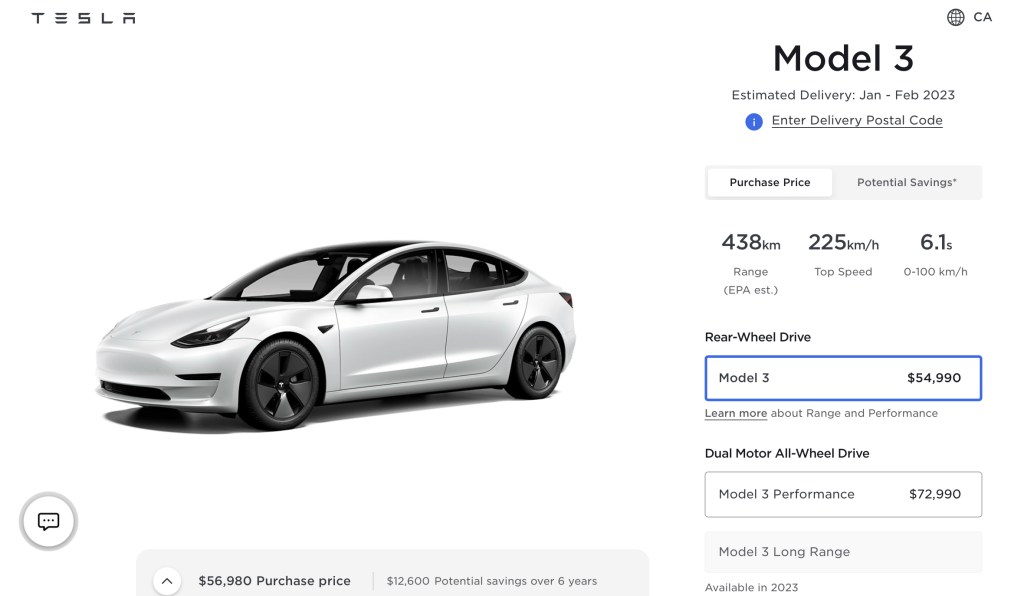

Tesla Slashes Prices in Canada, Model 3 Qualifies for Federal Rebate Again

As the part of global price cuts to boost demand, Tesla slashes prices across its lineup in Canada.

The price of base trim Rear-Wheel Drive Model 3 has been dropped from $59,990 to $54,990, meaning Model 3 RWD qualifies for federal iZEV $5,000 rebate again.

The price of entry level Model Y, Long Range All-Wheel Drive has been reduced from $85,000 to $69,990.

The price of base trim Model S has been reduced from $135,000 to $122,990.

The price of base trim Model X has been reduced from $156,000 to $142,990.

2023 Ontario Automotive Investment Could Be Better Than 2022

Ontario Minister of Economic Development Vic Fedeli predicted that 2023 Ontario automotive investment could be better than 2022. Vic reviewed on the province’s automotive successes of 2022 when guesting at the ANC’s Podcast and explained why the government now believes in financially assisting automakers.

2023 Canadian International AutoShow What To Expect

After 3 years waiting, Canadian International AutoShow is back. From February 17 to February 26, the 2023 Canadian International AutoShow will be held at the Metro Toronto Convention Centre (MTCC) in both the North and South Buildings, located in the heart of downtown Toronto.

Celebrating its coming 50th anniversary with an eye on the future of mobility, the Canadian International AutoShow is once again positioned to be Canada’s showcase of new vehicles, with a spotlight on exciting innovations that will shape the future of mobility.

We are expecting to see more new energy vehicles than ever. EVs and maybe other clean energy powered autos. If you’d like to learn more about EV, the exciting new feature exhibit Electric City is right for you. It is the one-stop destination for people to learn everything about automotive electrification. Learn from the ecosystem to developments in the electrified automotive industry, guided by experts discovering new options in mobility.

Another exciting new feature of the 2023 AutoShow will be Canada’s largest indoor EV Test Track. Guided by experts, you will be able to test drive the future of mobility, right inside the Metro Toronto Convention Centre.

Kids won’t be bored at the 2023 AutoShow. A life-size LEGO® Technic™ replica made from over 400,000 LEGO® Technic™ elements will make its North American debut.

In AutoExotica exhibition, you will see A curated selection of rare exotic cars, supercars and multimillion-dollar hyper cars. For fans of 80’s and 90’s automotive icons, the OBLIVION is a must-see exhibition.

You can find more activities at the 2023 AutoShow like Toronto Star Live Stage, AJAC Awards, etc.

Tesla cuts prices in China for the second time in 3 months

Tesla cut prices for Model 3 and Model Y in China for the second time in less than 3 months on Friday, January 6th. In late October 2022, Tesla announced price cuts up to 9% on Model 3 and Model Y. The latest cut in China, along with October’s price adjustment and recent incentives mean a 13% to 24% reduction in Tesla’s prices from September.

The starting price for Tesla Shanghai factory built Model 3 dropped to CNY¥229,990 (CAD $45,425) from¥265,900. The starting price of Model Y (rear-wheel drive, standard range) is CNY¥259,900 (CAD $51,351) , down from ¥288,900. Meanwhile in Canada, the starting price for Model 3 is CAD $59,990. The starting price for Model Y (all-wheel drive, long range ) is CAD $85,000.

Deliveries of Tesla Shanghai plant built cars hit their lowest in five months in December. According to the China Passenger Car Association (CPCA)’s report, Tesla delivered 55,5796 vehicles in December. The report shows Tesla’s biggest rival BYD delivered 234,598 vehicles.

BYD Launches Luxury EV Brand Yangwang with 1100 HP and 4 Motors

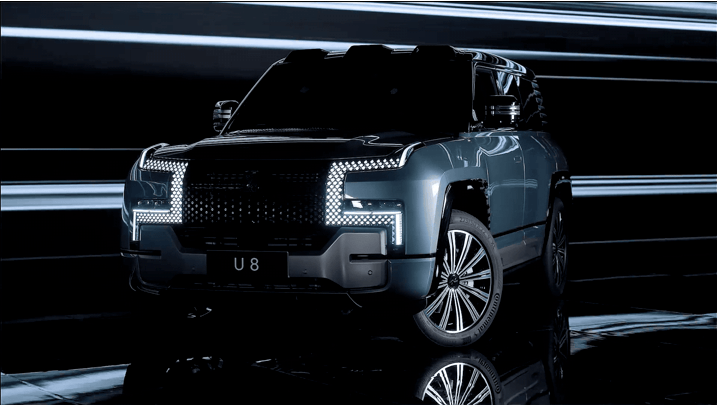
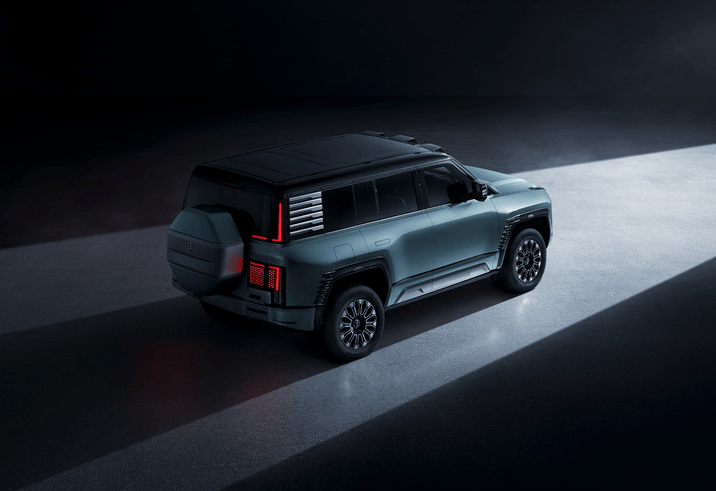
BYD’s luxury EV sub-brand Yangwang has launched U8, its first high-end, hardcore off-road SUV.

Yangwang U8 features an in-house e4 (Yisifang) architecture, using four IP68 sealed electric motors to drive each wheel independently with a central control unit. The e4 system provides over 1100 HP and more precise torque allocation which can achieve a 360-degree turnaround in one spot. With the help of over 1000 times per second real-time calculation by the control unit, the four-wheel independent motor system can control and stabilize the vehicle’s movement to help the driver in the situation such as flat tire. According to BYD, e4 system responds 100 times faster than the traditional four-wheel drive system and all models of Yangwang brand vehicles will be equipped. IP68 waterproof motors and body sealing technology enabling U8 to float on the water.

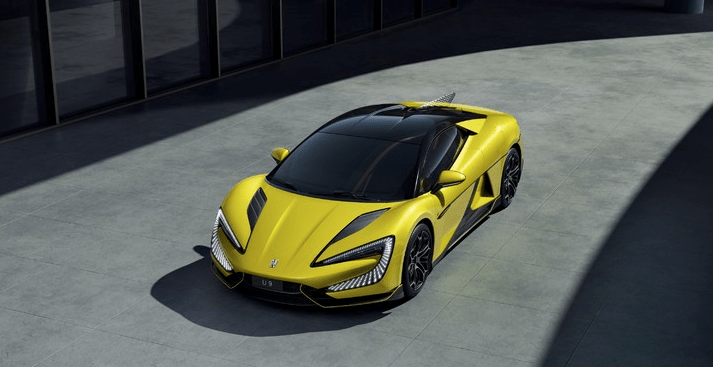
At the end of BYD’s event, it surprisingly revealed a sleek-looking supercar Yangwang U9. It also equips with e4 (Yisifang) four electric motor system. With the 820kW of power output U9 can accelerate to 100km/h in about 2 seconds. e4 system provides U9 torque-vectoring functions like crab walk and tank turn.

Canada’s First Full-Scale EV Plant

Canada’s first full-scale EV manufacturing plant opened in Ingersoll, Ontario on Monday, December 5th.

With the investment support of total $518 million from provincial and federal governments, GM has converted CAMI Assembly plant into the new global manufacturing home of BrightDrop’s fully electric delivery van. DHL will be the company’s first Canadian customer.

The first BrightDrop Zevo 600 rolled off the line at the plant on Monday.

Subaru Canada Announces First EV SUV Pricing

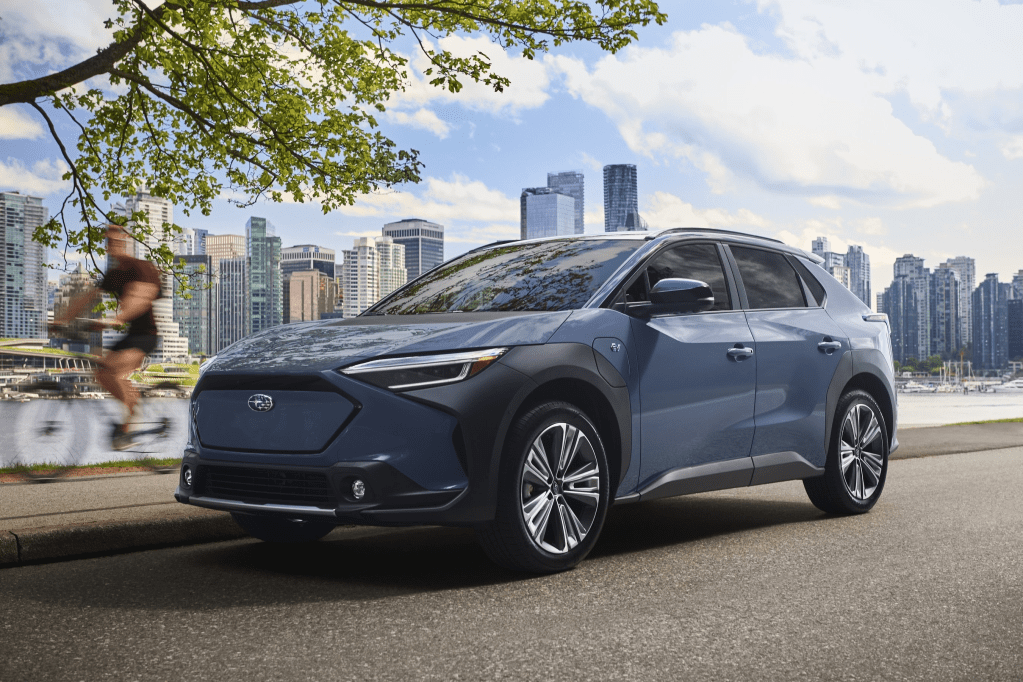
2023 Subaru Solterra marks the brand’s first all-electric SUV. Solterra will start at $54,295 with Symmetrical All-Wheel-Drive, 215 horsepower, 72.8 kWh battery and up to 360 kilometres range. A CCS1 combo charger allows for Level 1 and Level 2 AC and 100kW DC fast charging. The Level 2 charger is capable of charging from 10% up to 80% in 50 minutes.

By adding $4,100 you get the Luxury package which features with 360 degree camera, folding door mirrors, LED fog lamps, rain-sensing wipers, roof rails, a split design rear spoiler, 20 inch ally wheels, parking assist, and 2-tone paint options. With the Luxury package, the total MSRP is $58,395.

The Technology package cost $7,800 more than the standard model which brings the total MSRP to $62,095. Other than Luxury package features, it also includes a panoramic fixed glass roof with power retractable sunshade, a gloss black hood accent, rearview camera washer, and chrome window trim on solid colour cars or black on two-tone cars. Interior upgrades include ventilated front seats, ambient lighting, smart mirror with HomeLink and a tonneau cargo cover.

Automotive Industry Analysis 2021

The Canadian automotive industry had a challenging year in 2021, as the ongoing COVID-19 pandemic continued to disrupt production and sales. However, the industry has shown signs of recovery as vaccination efforts have gained momentum and restrictions have been lifted.

Automotive Industry Analysis 2021

Production and Sales

In terms of production, according to data from the Canadian Automotive Manufacturers’ Association (CAMA), vehicle production in Canada fell by 23.8% in 2020, with a total of 1.4 million units produced. However, production has been gradually recovering in 2021, with a total of 1.8 million units produced, an increase of 28.6% compared to 2020.

In terms of sales, the Canadian automotive market also saw a decline in 2020, with a total of 1.8 million vehicles sold, a decrease of 15.7% from the previous year. However, the market has shown signs of recovery in 2021, with total sales increasing by 13.6% during the first half of the year, reaching 972,000 vehicles sold.

As for the breakdown of vehicles, in 2021, Light trucks continue to be the most popular type of vehicle sold in Canada, with a market share of 63.8%. Passenger cars had a market share of 36.2%. Electric vehicles and hybrids represented 2.2% of the total sales in 2021.

Investment on EV

Despite these challenges, the Canadian automotive industry has continued to innovate and invest in new technologies. For example, many Canadian companies have been investing in electric and autonomous vehicle technology, as well as in connected and smart transportation solutions.

As of 2021, several Canadian automakers have released or announced plans to release electric and hybrid vehicles. For example, General Motors has announced plans to invest $1 billion in its Oshawa assembly plant in Ontario to produce electric vehicles, while Ford has announced plans to invest $1.45 billion in its Oakville assembly plant in Ontario to produce electric and hybrid vehicles.

The Canadian government has also announced plans to support the development and adoption of electric and hybrid vehicles. For example, the government has announced plans to invest $5 billion over the next five years to support the development and production of zero-emission vehicles and charging infrastructure. Additionally, several provinces, like Quebec and British Columbia, have their own EV incentive program to encourage citizens to buy electric vehicles.

Autonomous Vehicle Technology

In 2021, several Canadian companies have been making significant efforts in the development of autonomous vehicle technology.

BlackBerry QNX, a subsidiary of BlackBerry, which specializes in embedded systems and software for the automotive industry, has been working on developing advanced driver-assistance systems (ADAS) and autonomous vehicle technology for use in both cars and trucks. They have partnerships with major automakers such as Ford, BMW and Baidu to develop and deploy their autonomous driving platform.

Magna International, a Canadian multinational automotive supplier based in Ontario, has been working on developing autonomous vehicle technology, including sensors, software, and systems integration. Magna has partnerships with various companies in the automotive industry, including FCA, BMW, and Lyft, to develop and deploy autonomous vehicle technology.

Additionally, there are several startups in Canada working on autonomous vehicle technology. For example, Ottawa-based company, Ottawa-based Kinova Robotics, which designs, develops and manufactures robots for a wide range of applications, including autonomous vehicles. Also, the Toronto-based company, Clearpath Robotics, which designs and manufactures robots for industrial and research applications, including autonomous vehicles and drones.

Summery

The Canadian automotive industry faced significant challenges in 2021 due to the ongoing pandemic, but has shown signs of recovery as the year progressed, with production and sales both showing improvement. Additionally, the industry continues to innovate and invest in new technologies, positioning it well for the future.

Automotive Industry Analysis 2020

The Canadian automotive industry faced significant challenges in 2020 due to the ongoing COVID-19 pandemic. The industry saw a decline in production and sales, as well as a shift in consumer demand towards electric and hybrid vehicles. Despite these challenges, the industry has continued to innovate and make progress in the development of electric vehicles (EVs) and advanced driver-assistance systems (ADAS).

Production and Sales

In terms of production, according to data from the Canadian Automotive Manufacturers’ Association (CAMA), vehicle production in Canada fell by 23.8% in 2020, with a total of 1.4 million units produced. This decline was primarily due to the shutdowns and slowdowns at assembly plants as a result of the pandemic. This is a significant decrease compared to 2019, where 2.4 million units were produced.

In terms of sales, the Canadian automotive market also saw a decline in 2020, with a total of 1.8 million vehicles sold, a decrease of 15.7% from the previous year. This is a significant decrease compared to 2019, where 2.2 million vehicles were sold. The decline in sales was primarily due to the impact of the COVID-19 pandemic on consumer demand and dealership operations.

As for the breakdown of vehicles, in 2020, Light trucks continue to be the most popular type of vehicle sold in Canada, with a market share of 63.9%. Passenger cars had a market share of 36.1%. Electric vehicles and hybrids represented 1.5% of the total sales in 2020, which is a small but growing segment of the market.

Investment for New Energy Vehicles

The Canadian government has also announced plans to support the development of electric and other new energy vehicles.

in 2019, the Federal Government announced the $130 million Zero-Emission Vehicle Infrastructure Program (ZEVIP) to support the installation of electric vehicle charging stations across Canada. The program provides funding for the installation of electric vehicle charging stations in various settings, including workplace, multi-unit residential buildings, and public places.

In 2020, the Federal Government also announced the $5 billion Low Carbon Economy Fund to support provinces and territories in their efforts to reduce greenhouse gas emissions and fight climate change. The fund is intended to support a wide range of clean energy projects, including electric vehicle infrastructure, renewable energy, energy efficiency, and more.

The iZEV (Incentive for Zero-Emission Vehicles) program continues to provide incentives for the purchase or lease of new battery electric, hydrogen fuel cell, and longer-range plug-in hybrid vehicles.

The battery electric vehicles (EVs) eligible for the iZEV program are vehicles that are powered solely by electricity and have a battery capacity of at least 15 kilowatt-hours (kWh). Hydrogen fuel cell vehicles eligible for the iZEV program are vehicles that are powered by hydrogen fuel cells and have a range of at least 40 kilometers using the New European Driving Cycle (NEDC) test procedure.

Plug-in hybrid electric vehicles (PHEVs) eligible for the iZEV program are vehicles that have a battery capacity of at least 15 kWh and an all-electric range of at least 35 kilometers using the NEDC test procedure.

Additionally, several provinces, like Quebec and British Columbia, have their own EV incentive program to encourage citizens to buy electric vehicles.

EV Sales

According to data from FleetCarma, an electric vehicle research firm, Electric vehicle (EV) sales in Canada in 2020 were around 26,437 units, which represents 1.5% of the total vehicle sales in the country. This represents an increase from 2019, when EV sales were around 17,704 units, or 0.8% of total vehicle sales. It’s a significant increase, but still a small percentage of the total market share.

In terms of production, there were no major EV production facilities in Canada in 2020. Canadian automakers have focused on traditional internal combustion engines (ICE) vehicles, while most of the EV models sold in Canada were imported from other countries.

In terms of customer demand, there has been a shift in consumer demand towards electric and hybrid vehicles. The iZEV program has helped to increase the market share of electric vehicles in Canada from 0.5% in 2019 to 1.5% in 2020. Additionally, increasing concerns about the environment and the desire for more fuel-efficient vehicles have led to a growing demand for EVs.

Summary

In summary, the Canadian automotive industry faced significant challenges in 2020 due to the ongoing COVID-19 pandemic, resulting in a decline in production and sales. Despite these challenges, the industry has continued to innovate and make progress in the development of electric vehicles and advanced driver-assistance systems. The industry also saw a shift in consumer demand towards electric and hybrid vehicles and the Canadian government has been providing support to encourage the adoption of these vehicles.

Design a site like this with WordPress.com
Get started